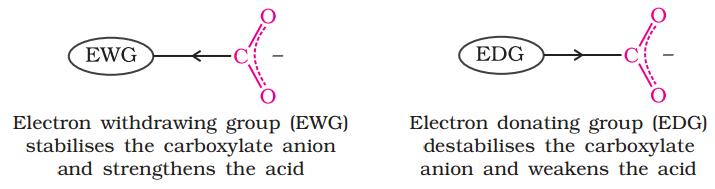
The α-hydrogens of ketones tend to be slightly less acidic than those of aldehydes due to the electron-donating properties of the additional alkyl group in a ketone.
Note: This property is the same reason that alkyl groups help to stabilize carbocations—but in this case, they destabilize the carbanion.
Note ↑: Through induction, oxygen pulls some of the electron density out of these C–H bonds, weakening them. This makes it relatively easy to deprotonate the α-carbon of an aldehyde or ketone, as shown in Figure 7.1.
Note ↑: The pKa values of aldehyde and ketone -hydrogens range from 16 to 21, much lower than
the pKa values of ethene (44) or ethyne (25), but comparable with those of alcohols (15–18).
Strong bases can therefore remove an -hydrogen. The anions that result are known as
enolate ions or simply enolates.
Why are aldehydes and ketones relatively acidic?
We know that acid strength is enhanced
by stabilization of the conjugate base. In the enolate ion, the inductive effect
of the positively polarized carbonyl carbon strongly stabilizes the negative charge at the
-position. Aldehydes are stronger acids than ketones because their carbonyl carbon bears a
larger partial positive charge. Further strong stabilization is provided by delocalization of charge onto the electronegative oxygen, as described by the resonance forms
just pictured. The effect of delocalization is also reflected in the electrostatic potential map
of the acetone enolate shown down below (on an attenuated scale), which exhibits negative
charge (red) on the -carbon as well as on the oxygen. An example of quantitative enolate
formation is the deprotonation of cyclohexanone (pKa = 19) by lithium diisopropylamide (LDA,
pKa of amine = 36).