Question
Molecules that do not experience a change in dipole moment are ____.
Answer
Molecules that do not experience a change in dipole moment are those composed of atoms with the same electronegativity or molecules that are symmetrical.
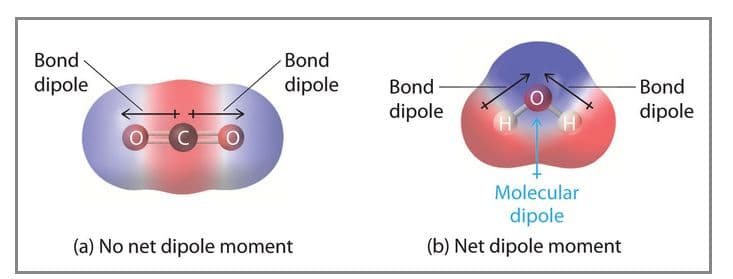
Example: We cannot get an absorption from O2 or Br2, but we can from HCl or CO. Symmetric bonds, such as the triple bond in acetylene (C2H2), will also be silent.
Note: And by extension, they do not exhibit absorption.
Note ↑: Raman spectroscopy occurs as a result of a molecular vibration causing a "change in polarizability" of the molecule. In contrast, for a molecule to be infrared active, the vibration must cause a change in the permanent dipole moment. A simple case of a Raman Active molecule would be a species such as CS2. The symmetrical stretch out and then in (pictured to the right) will be detected by Raman spectroscopy. Since the molecule has no permanent dipole, this stretch would be invisible in an infrared spectra, represented in the diagram ↓.
Keep this card coming back until it sticks
Sign up free and spaced repetition will bring Chapter 11: Spectroscopy cards back right before you forget them.
Continue studying — sign up freeMore cards in Chapter 11: Spectroscopy
Infrared (IR) spectroscopy measures ____.
Molecular vibrations can be seen as ____.
To record an IR spectrum, i____e is measured.
The infrared light range runs from λ = ____.
The useful absorptions for infrared spectroscopy occur at wavelengths of ____ nm.
On an IR spectrum, we use an analog of ____ called wavenumber.